Short answer: divide the tent’s advertised capacity in half. A 6-person tent comfortably sleeps a family of 3-4 with gear, an 8-person tent fits a family of 5-6, and a 4-person tent is really a two-adult tent once you add an air mattress. For a family of four, a 6-person tent with 90-100 sq ft of floor space is the sweet spot.
But there’s a second number nobody talks about, and it’s the one that ruins trips: the tent pad at your campsite. Many campgrounds give you a pad of 10×10 to 12×12 feet, and Yellowstone and Grand Teton publish a hard 12′ x 12′ maximum. Buy the 10-person tent that every size chart recommends for your family of six, and it physically will not fit on the site you reserved.
We found that out at 7pm on a Friday, holding a 14-foot tent over a 12-foot gravel pad while our kids asked why we weren’t done yet. Here’s how to get the size right the first time.
Why Tent Capacity Ratings Are Basically Fiction
Tent manufacturers rate capacity by how many adult bodies fit shoulder to shoulder on the floor, lying flat, with nothing else in the tent. No gear. No air mattress. No space to walk. No dog. No diaper bag.
That’s the industry standard, and every brand uses it, so a “6-person tent” from Coleman and a “6-person tent” from REI are measuring the same unrealistic scenario. It’s not dishonest exactly, it’s just a spec that has nothing to do with how families actually sleep.
The fix is simple and it’s what every experienced camper does: halve the number. Then check the actual floor dimensions in inches, because that’s the spec that tells the truth.
Family Tent Size Chart
Here’s the translation from marketing number to reality, including what actually fits on the floor:
The Rule Nobody Tells You: Check the Tent Pad First
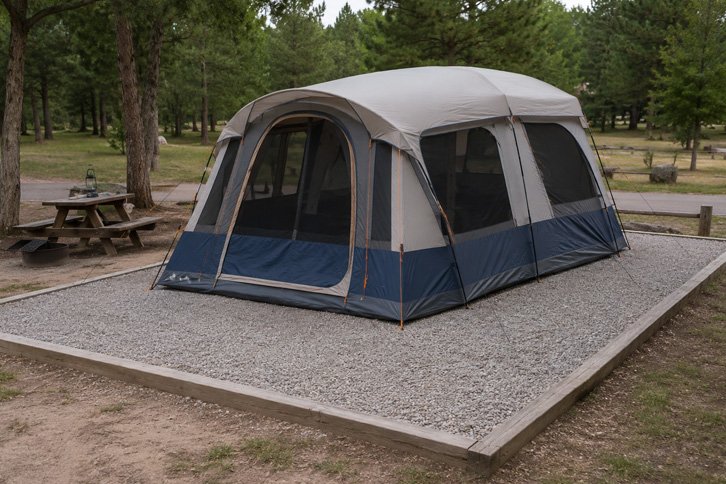
Most campsites reserved through Recreation.gov or a state park system include a designated tent pad, a leveled gravel or dirt rectangle where your tent is supposed to go. Typical pads run 10×10 to 12×12 feet. Some campgrounds go up to 15×20, plenty don’t.
Yellowstone and Grand Teton both publish a 12′ x 12′ maximum tent footprint for many of their sites. Colter Bay Campground at Grand Teton lists pads at 12×12 and 14×14. If your tent’s floor is 14 feet long, it doesn’t fit, full stop.
And the floor isn’t the whole story. Rain flies on large family tents extend well past the floor, often 12 to 24 inches on each side. A tent with a 12-foot floor can need 14 feet of ground once the fly is staked out properly.
How Much Space Does Each Person Actually Need?
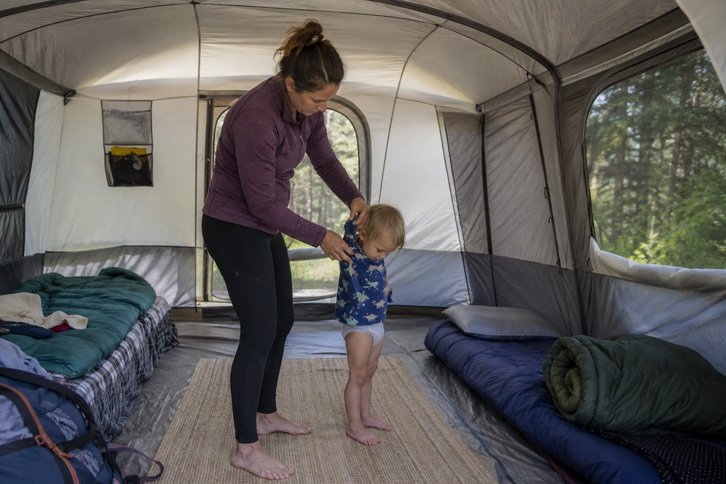
The industry rule of thumb is 20 sq ft per person, but that’s the bare minimum for lying down. For families it breaks down like this:
- 20 sq ft per person, sleeping bags on the floor, nothing else, everyone touching
- 25-30 sq ft per person, comfortable sleeping pads, a little gear, room to roll over
- 30-40 sq ft per person, air mattresses, a walking lane, gear inside, actual comfort
Families should plan for 30-40, not 20. Kids sprawl. Air mattresses take double the footprint of a sleeping pad. And when it rains for two days straight, that tent becomes a living room, not a bedroom.
Does a Queen Air Mattress Fit?
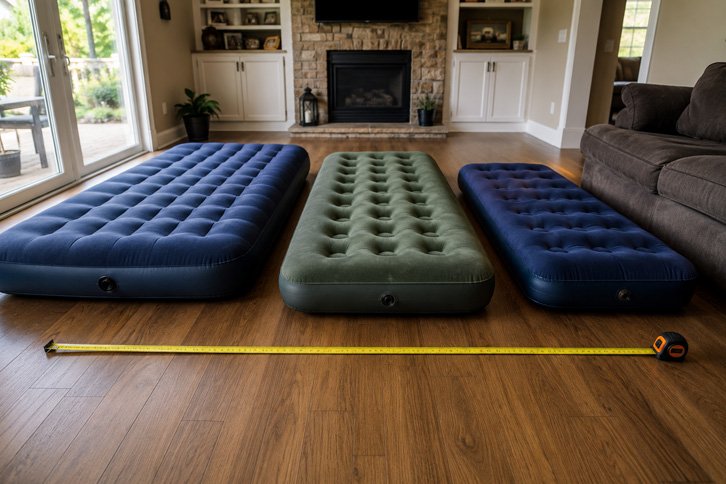
This is the question that decides most family tent purchases, so here are the real numbers:
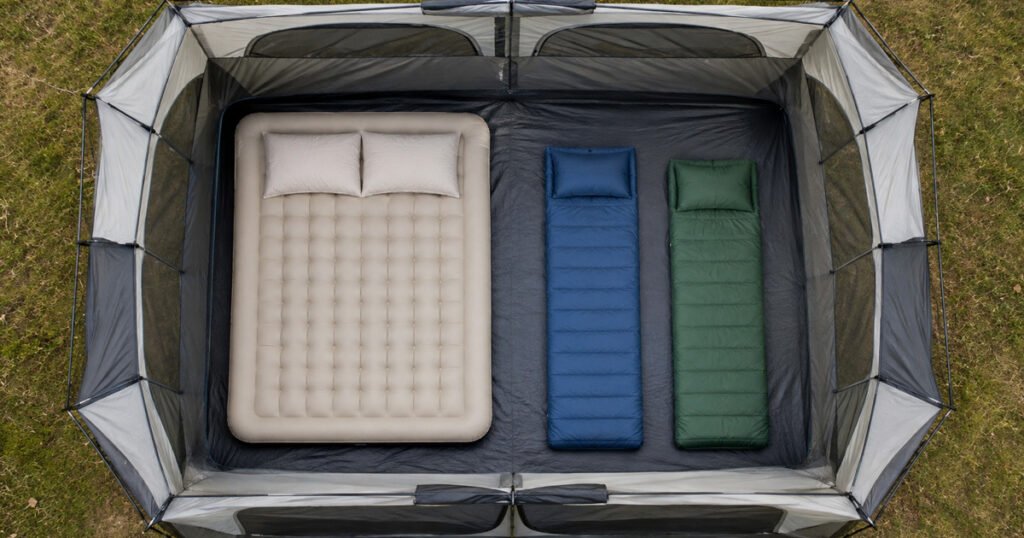
- Queen air mattress: 80″ x 60″ (about 33 sq ft)
- King air mattress: 84″ x 72″ (about 42 sq ft)
- Twin air mattress: 75″ x 39″ (about 20 sq ft)
A queen fits in a 4-person tent like the Coleman Sundome 4 (108″ x 84″), but you’ll have roughly a foot of walkway left and your gear lives in the car. In a 6-person tent (typically 120″ x 120″), a queen fits with genuine room to spare for kids’ pads, a lantern, and a duffel.
Three twin mattresses at 39″ wide total 117″ — which means they fit wall to wall in a 120″-wide 6-person tent with almost nothing between them. Technically it works. Practically, nobody can get out to pee at 3am without stepping on a sibling.
Don’t Forget Peak Height
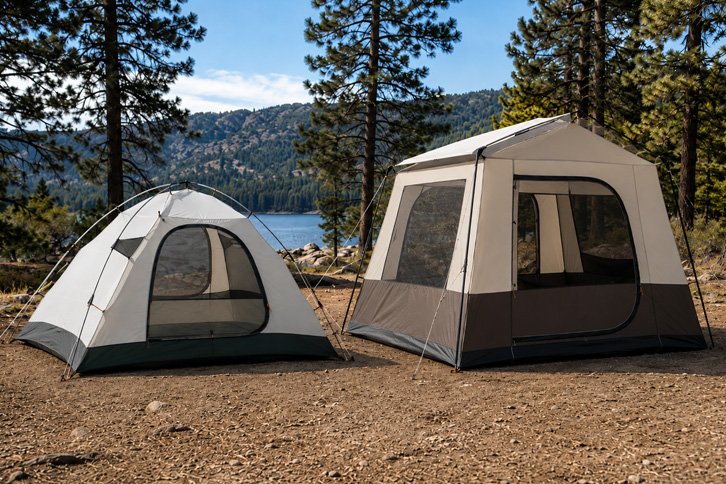
Floor space gets all the attention, but peak height decides whether your tent feels like a shelter or a nylon coffin. Two numbers matter:
- Under 5 ft peak, dome tent, you’re crawling and kneeling. Fine for two adults, miserable for changing a toddler.
- 6 ft or more peak, cabin-style tent, most adults stand up straight. Changing clothes, dressing kids, and riding out a rainstorm all get dramatically easier.
Peak height is also measured at a single center point. A dome tent with a 6-foot peak has sloping walls, so you can only stand in a small circle in the middle. A cabin tent with near-vertical walls gives you that height across most of the floor, which is why families gravitate toward them.
Measure Before You Buy: A 10-Minute Method
Do this on your living room floor before you spend $300. It takes ten minutes and it’s the single best thing you can do to avoid buying wrong.
- Lay out your actual sleep setup. Put down the air mattresses, sleeping pads, and pack ‘n play you plan to bring. Real gear, not estimates.
- Measure the rectangle it occupies. Tape measure, length and width, write it down in inches.
- Add 24 inches to each dimension. That’s your walking lane and gear space. Without it, you’re stepping on someone every time you get up.
- Compare that to tent floor dimensions, not person ratings. Shop by inches. Then check it against the tent pad limit at the campground you’re booking.
If your family’s setup measures 100″ x 80″, add the buffer and you need roughly 124″ x 104″, about 10.3 x 8.7 feet. That’s a 6-person tent, and now you know it for a fact instead of guessing from a box.
Common Sizing Mistakes Families Make
- Trusting the person rating. A 4-person tent for a family of four means four people wedged in with zero gear. Halve it, always.
- Buying the biggest tent you can afford. Bigger tents take longer to pitch, need more stakes, catch more wind, and may not fit your campsite. Bigger isn’t automatically better.
- Ignoring the tent pad. The most expensive sizing mistake, because you find out on arrival with nothing you can do about it.
- Forgetting the dog. A medium dog claims about the floor space of a small child, and picks the worst possible spot to do it.
- Sizing for today’s kids. A tent lasts 5-10 years. Your 4-year-old will be 12 and nearly adult-sized before you replace it.
Which Size Should You Buy?
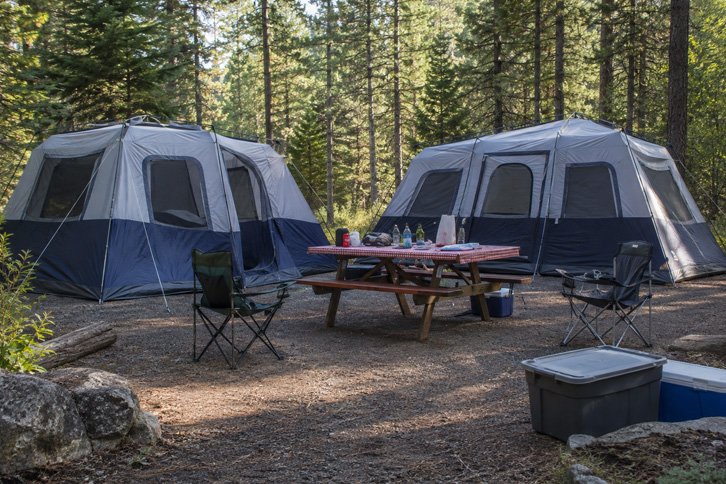
Couple, or two adults and a baby: 4-person tent. Enough for a queen mattress and a pack ‘n play if you’re organized about it. Go 6-person if you want gear inside.
Family of four (2 adults, 2 kids): 6-person tent. This is the default answer for most families reading this, and it fits nearly every campground pad.
Family of five or six: 8-person tent, ideally cabin style with room dividers so kids and parents get separate spaces. Verify the pad size before booking.
Family of six or more, or you camp with another family: 10-person tent or two smaller tents. Two 6-person tents often work better than one giant tent, they fit on more sites, pitch faster, and give teenagers their own space.
Next Steps
Once you’ve settled on a size, go straight to the roundup for that capacity:
- 4-person: Best 4-Person Tents, for couples, or a small family that packs light
- 6-person: Best 6-Person Tents, the family default
- 8-person: Best 8-Person Tents, families of five or six
- 10-person: Best 10-Person Tents, big families and multi-family trips
- Camping with little ones: Camping with Toddlers, sizing is different when someone naps mid-afternoon
Frequently Asked Questions
How many people actually fit in a 6-person tent?
A 6-person tent comfortably fits 3-4 people with gear, not six. Manufacturers rate capacity by how many adults can lie shoulder to shoulder with no gear and no walking space, so the practical rule is to halve the advertised number. A 6-person tent has roughly 90-100 sq ft of floor, which suits a family of four with sleeping pads or a queen air mattress plus two kids.
What size tent do I need for a family of four?
A 6-person tent is the right size for most families of four. That gives you 90-100 sq ft, enough for a queen air mattress plus two kids’ pads with a walking lane, or three twin mattresses side by side. A 4-person tent will technically hold four people, but with no room for gear and no space to move.
Does a queen air mattress fit in a 4-person tent?
Yes, but barely. A queen air mattress measures 80″ x 60″, and a typical 4-person tent like the Coleman Sundome 4 has a 108″ x 84″ floor, leaving about a foot of clearance for gear and movement. A 6-person tent is the more comfortable choice for a queen setup, since 120″ x 120″ leaves genuine room around the bed.
How many square feet per person do you need in a tent?
Plan on 30-40 sq ft per person for family camping. Twenty square feet per person is the industry minimum and only works for sleeping bags directly on the floor with no gear. Twenty-five to 30 sq ft allows sleeping pads and some belongings, while 30-40 sq ft accommodates air mattresses, gear stored inside, and room to walk between beds.
Is there a maximum tent size at campgrounds?
Often yes. Many campgrounds provide a designated tent pad of 10×10 to 12×12 feet, and some parks publish a hard limit, Yellowstone and Grand Teton both list a 12′ x 12′ maximum tent footprint for many sites. Check the site details on your reservation or call the campground before buying a large tent, and remember that rain flies extend 12 to 24 inches beyond the tent floor.
Should I buy a bigger tent than I need?
Size up one step from your family count, but not more. A family of four buying a 6-person tent gains comfort and gear space at little cost. Jumping to a 10-person tent adds setup time, weight, wind exposure, and the real risk that it won’t fit on your campsite’s tent pad.
What peak height should a family tent have?
Look for at least 6 feet of peak height if you want adults to stand up inside. Cabin-style tents with near-vertical walls give you that height across most of the floor, while dome tents with the same listed peak only allow standing in a small area at the center. Standing room matters most for changing kids’ clothes and waiting out rain.