If you need the short answer: the Claymore V600+ is the best tent fan for most families. It pushes a strong range of wind speeds, runs up to 31.5 hours on a charge, and has enough hanging and mounting options to work in almost any tent. If you want a fan that doubles as a lantern for the kids’ side of the tent, the Nitecore NEF10 is the better pick and it’s noticeably cheaper. And if you’re cooling down more than one sleeping area at once, the Geek Aire Rechargeable Fan pushes air a lot further than the smaller options.
We’ve camped through more than a few 85°F nights where the tent felt like a greenhouse by 8pm, and a decent fan is genuinely the difference between everyone sleeping and everyone lying awake sweating. Here’s what actually works, based on real testing data from hands-on reviewers, not just spec sheets.
Quick Top 3 Picks
- Best Overall: Claymore V600+, the strongest all-around mix of airflow, runtime, and mounting options
- Best Value: Nitecore NEF10, nearly as good as the Claymore, with a built-in lantern, for about half the price
- Best for Groups/Kids’ Room: Geek Aire Rechargeable Fan, pushes air the farthest, so it can cool two sleeping areas at once
Comparison Table
Individual Mini-Reviews
Claymore V600+
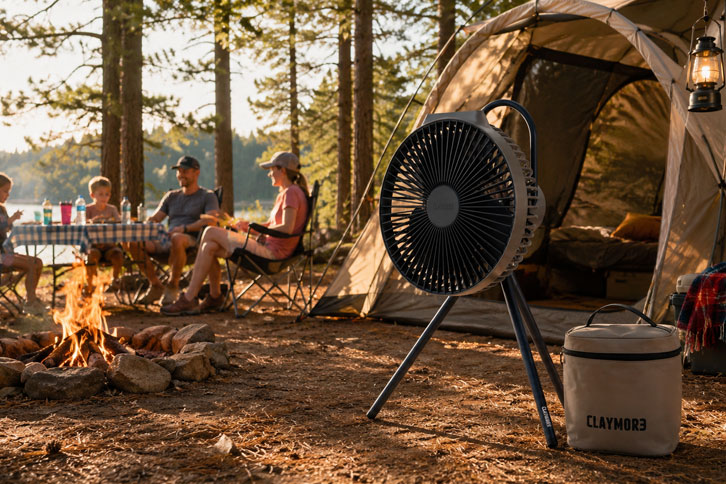
The Claymore earns its spot at the top because it doesn’t make you choose between power and runtime. It has four wind speed settings, from a gentle 2.6 m/s up to a strong 4.2 m/s, and even at the highest setting you’re getting real airflow across the tent, not just white noise. On its lowest setting it stretches out to about 31.5 hours, which covers most weekend trips without needing a recharge.
It also comes loaded with the small details that matter at 11pm in a dark tent: a hanging hook and carabiner, adjustable legs so it stands on uneven ground, a 360-degree rotating head, and a sleep timer so it shuts off instead of running all night. The trade-off is that it skips two features some competitors have: it doesn’t include a light, and it can’t charge your phone.
Nitecore NEF10
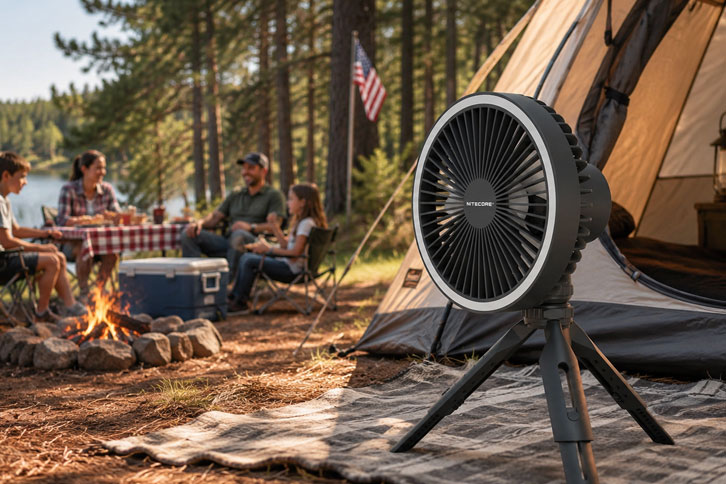
If the Claymore is slightly out of budget, the NEF10 gets you nearly the same performance for about half the price, plus a feature the Claymore doesn’t have: a built-in lantern with three brightness levels (34 to 124 lumens) that works great as a soft night light for a kid who doesn’t love total darkness. It also runs a little longer than the Claymore on paper and is noticeably quieter, even at its highest speed setting.
The one real weak spot: it’s not built for heavy rain. A reviewer who tested it left it out through 30 minutes of a downpour and the fan function stopped working (it did recover after a few months of drying out, but that’s not a bet you want to make on a real trip). Keep this one under your rainfly or vestibule, not out in the open.
Geek Aire Rechargeable Fan
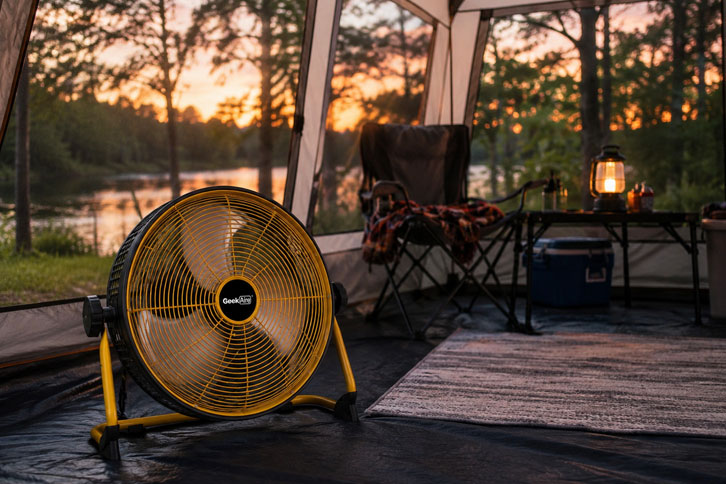
Once you’ve got more than two people trying to sleep in the heat, the smaller fans start to feel like they’re only cooling whoever’s closest. The Geek Aire solves that with an 8.5-inch blade (available in 10, 12, or 16-inch versions) that pushes air noticeably further, enough to reach across a family-sized tent and cool a kids’ sleeping area on the far side.
It’s also the only fan on this list made mostly of metal, and it carries an IPX4 water-resistance rating, so a stray splash from a leaky rainfly won’t take it out like it did the Nitecore. The downside is size and battery: it’s bulkier to pack, and despite being the biggest fan here, it actually holds less battery capacity than the smaller Claymore or Nitecore, so expect shorter runtimes on the higher speeds.
O2Cool Treva 10-Inch and Odoland Camping Fan
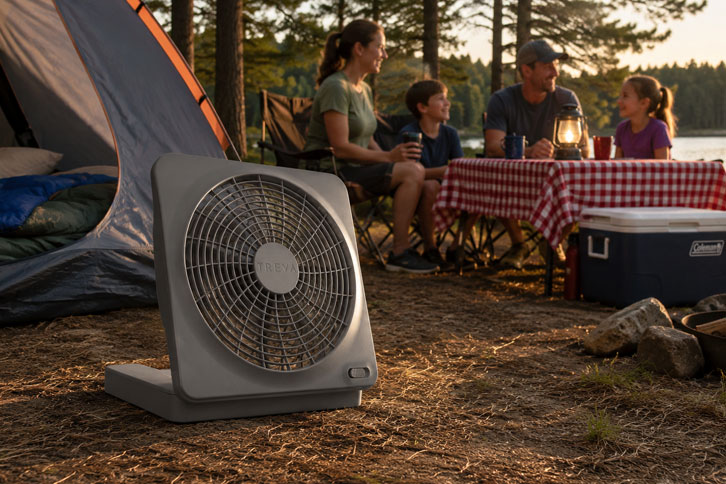
The O2Cool Treva is the fan we’d point RV and car campers toward. It runs on batteries but also pairs with an optional solar panel accessory, so it’s a solid pick if you’re parked at a campsite for several days and don’t want to worry about recharging anything. It’s not as powerful as the Claymore or Geek Aire, but for a fan you mostly leave running at a fixed campsite, that’s a fair trade.
The Odoland Camping Fan is the one to grab if you’re an occasional camper who just needs a basic fan for one or two trips a year and doesn’t want to spend much. It runs on two D batteries, has the longest runtime of anything on this list (about 40 hours), but its smaller 4-inch blade means it’s really a personal fan, not something that cools a whole tent. Skip it if you’re camping regularly or with more than 2 people in the tent.
Buying Guide
Airflow and Wind Speed
Look for a fan with at least a couple of speed settings, measured in wind speed (m/s) or CFM. A single-speed fan either isn’t strong enough on hot nights or is too loud to sleep next to on cooler ones. The Claymore and Nitecore both offer 4 distinct speeds, which is the range that actually gets used in practice.
Runtime and Power Source
Rechargeable fans like the Claymore, Nitecore, and Geek Aire are convenient for weekend trips since you charge them at home or in the car. Battery-powered fans, like the Odoland, are easier to keep running on longer trips since you can pack spares, and the O2Cool’s solar option is worth it if you’re staying at one campsite for several days.
Noise Level
A fan that’s too loud defeats the purpose. Quieter models like the Nitecore NEF10 are worth prioritizing if anyone in your family is a light sleeper, nobody wants a machine-hum fight with a toddler at 2am.
Water Resistance
If your fan is going to spend any time outside the vestibule or in a screen room, an IPX4-rated model like the Geek Aire holds up much better to a surprise drizzle than the Nitecore, which needs to stay fully covered.
📋 Sorting out how to keep the whole tent cool this summer, not just moving the air around? Best Camping Tents with AC Port for Summer CampingFinal Verdict
Best Overall: The Claymore V600+ has the strongest mix of airflow, runtime, and mounting flexibility of anything we found, and it’s worth the extra cost if you camp often.
Best Value: The Nitecore NEF10 gets you nearly the same performance for about half the price, plus a built-in lantern, just keep it dry.
Best for Groups/Kids’ Room: The Geek Aire Rechargeable Fan is the one to buy if you need airflow to reach across a bigger tent or a separate kids’ sleeping area.
If you only buy one fan from this list, the Claymore V600+ covers the most ground: strong airflow, real all-night runtime, and mounting options for almost any tent layout. Skip it if budget is the priority on a first trip – the Nitecore NEF10 gets you 90% of the performance, plus a lantern, for a lot less.
Check Price on Amazon →Frequently Asked Questions
Do tent fans actually make a difference in hot weather?
Yes, especially when paired with open mesh vents. A fan won’t lower the actual temperature inside the tent, but it moves stale, humid air out and creates a wind-chill effect on your skin that makes the heat far more bearable for sleeping.
What’s the best tent fan for a family with kids?
The Geek Aire Rechargeable Fan pushes air the farthest, which helps if kids are sleeping on the far side of a larger tent. Whichever fan you choose, mount it up high on a hook or shelf, out of reach of small hands and crawling babies.
Can I run a tent fan all night?
Most rechargeable models like the Claymore and Nitecore include a sleep timer specifically for this, so the fan shuts off automatically instead of draining the battery or running unnecessarily once everyone’s asleep.
Are rechargeable or battery-powered tent fans better?
Rechargeable fans are more convenient if you can charge them at home or in the car between trips. Battery-powered options, like the Odoland, are easier to keep running on longer trips since you just pack spare batteries, and solar-compatible models like the O2Cool Treva work well for extended stays at one campsite.
Do tent fans work in the rain?
It depends on the model. The Geek Aire has an IPX4 water-resistance rating and held up fine in testing. The Nitecore NEF10 is not rain-resistant and should stay under your rainfly or in a dry vestibule.
How loud are camping tent fans?
It varies a lot by model. The Nitecore NEF10 was the quietest fan tested, even at its highest speed setting, which matters if you have a light sleeper in the tent.