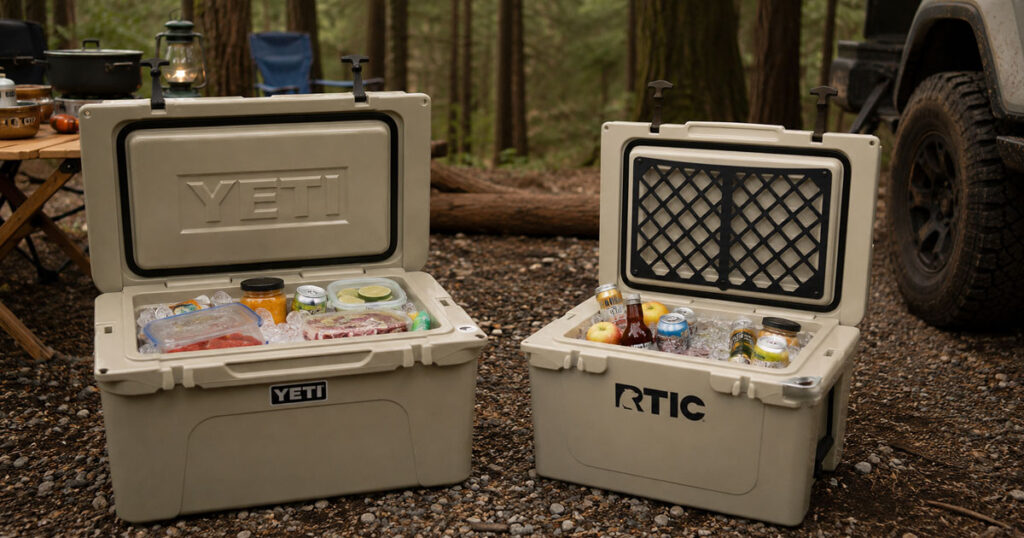
Short answer: no, YETI isn’t really worth 2x the price for most families. The RTIC 45 costs about $239 (versus $325 for the YETI Tundra 45) and comes within a few degrees of the same ice retention in real-world testing. YETI still wins on long-term durability and warranty, so if you camp constantly and plan to keep this cooler for a decade, it’s a defensible splurge. For everyone else, RTIC gets you 90% of the performance for roughly 70% of the price.
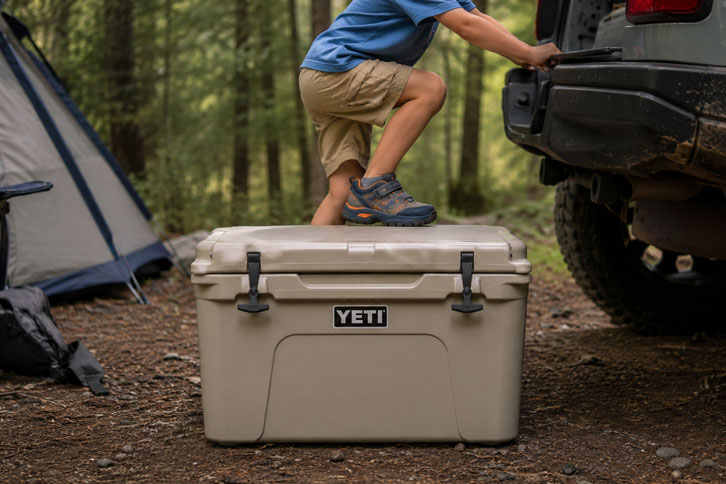
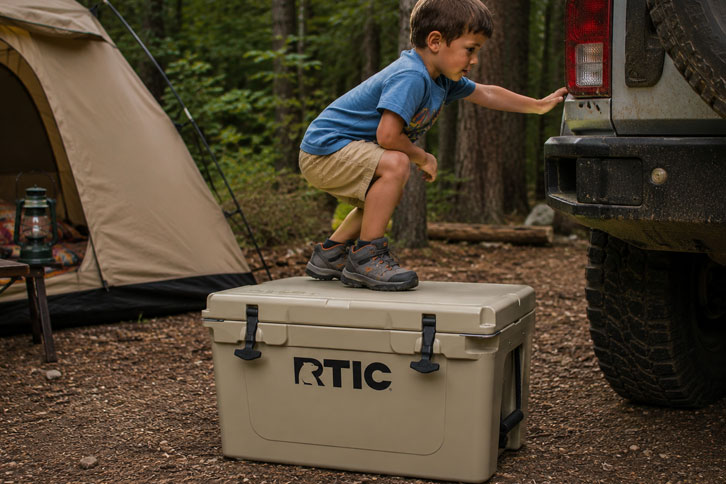
We’ve owned both. We’ve also watched a 6-year-old use each one as a bench, a step stool, and briefly a boat. Here’s how they actually compare once you get past the marketing.
YETI Tundra 45 vs RTIC 45: Side-by-Side Specs
Price: RTIC Wins, But the Gap Has Narrowed
RTIC used to be the “budget YETI.” That reputation is outdated. At $239, RTIC now sits in premium-accessible territory, not true budget, if you want a genuinely cheap cooler, look at something like the Coleman Xtreme instead. What RTIC actually offers is roughly $85-100 in savings over YETI for a cooler built the same way, from the same rotomolded construction process.
Ice Retention & Performance: Close Enough Not to Matter for a Weekend
Independent heat tests with the lid opened and closed repeatedly (to simulate a family actually using the cooler) show YETI and RTIC nearly tied through day 3-4. YETI pulls a little ahead after that, but most family trips wrap up before the gap becomes real. If your typical trip is a 2-4 night weekend, you will not notice a meaningful difference in the cooler itself.
Durability & Build Quality: YETI’s Reputation Is Earned, Just Not Essential
Both coolers use rotomolded construction, thick walls, and a rubber gasket seal. YETI’s is slightly more refined , tighter latches, a marginally better gasket, and it shows after years of hard use. RTIC’s build quality is genuinely good, not a corner-cut version of YETI’s, but it won’t survive quite as many seasons of a kid standing on the lid every single trip.
Weight & Portability: RTIC Is the Easier Cooler to Live With
At 7.5 lbs lighter empty, RTIC is noticeably easier to lift into a trunk, especially when you’re also managing a stroller, a diaper bag, and a toddler who wants to help carry something. The RTIC Ultralight Wheeled version (~$300, 42 QT) pushes this further with puncture-proof wheels and a silicone cargo net inside the lid to keep sandwiches out of the ice.
Warranty & Resale Value: The Real Argument for YETI
This is where YETI’s price actually earns its keep for some families. A 5-year warranty versus RTIC’s 1 year matters if you plan to camp for the long haul, and YETI coolers hold resale value noticeably better if you ever upgrade or downsize. If camping is a one-or-two-summers experiment for your family, this advantage is close to irrelevant. If you’re building a decade of camping trips, it’s the strongest case for paying more upfront.
YETI Tundra 45: Pros & Cons
RTIC 45: Pros & Cons
Verdict: Which to Pick Based on Your Situation
- Pick YETI if: you camp several times a year, plan to keep this cooler for a decade, camp in bear country, or care about resale value when you eventually upgrade.
- Pick RTIC if: you camp occasionally to regularly, want to save $85-100 without a real performance trade-off, or need something lighter to haul with kids in tow.
- Skip both if: your budget is under $100 or you camp fewer than a handful of times a year, grab a Coleman Xtreme or Igloo Quantum instead and put the savings toward gear you’ll actually notice.
For the vast majority of family camping trips, the RTIC 45 delivers ice retention close enough to YETI that you won’t notice the difference on a weekend trip, at $85-100 less. Upgrade to YETI only if you camp constantly, need certified bear resistance, or want the longest possible warranty.
Check Price on Amazon →Frequently Asked Questions
Is YETI really worth 2x the price of RTIC?
For most families, no. Independent testing shows YETI and RTIC are nearly tied on ice retention through day 3-4, which covers most weekend trips. YETI pulls ahead slightly after that and offers a longer warranty and certified bear resistance, which matter mainly to frequent or backcountry campers.
Is RTIC still considered a budget cooler?
Not really. At $239, RTIC now competes in premium-accessible territory, not true budget. If you want a genuinely cheap cooler, look at options like the Coleman Xtreme or Igloo Quantum, which run under $100.
Which cooler is better for camping in bear country?
YETI, if certified bear resistance matters for your campsite. YETI offers IGBC-certified bear-resistant models; RTIC does not currently offer a certified option.
Do RTIC coolers really keep ice as long as YETI?
Close to it. Testing with the lid opened and closed repeatedly to simulate real use shows RTIC nearly matching YETI through the first 3-4 days. The gap widens after day 4-5, which won’t affect most weekend or long-weekend trips.
Is the RTIC 45 or the RTIC Ultralight Wheeled better for families?
The Ultralight Wheeled version (~$300, 42 QT) is worth the extra cost if you’re hauling the cooler any real distance from the car, since it adds wheels and an in-lid cargo net for snacks. The standard RTIC 45 is fine if you’re only carrying it a short distance.
How much can I save buying RTIC instead of YETI?
Around $85-100 at full price, and the gap can widen further during sales — RTIC has dropped to around $207 during Black Friday, versus YETI’s typical sale price of about $260.