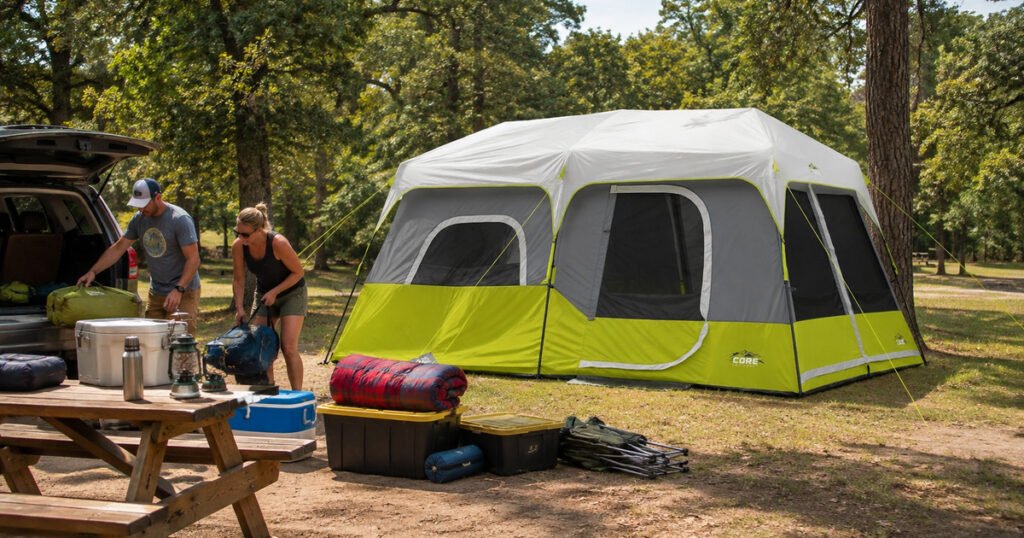
Short answer: the Core 9-Person Instant Cabin Tent really does set up in under two minutes once the poles are extended, and the vertical walls make it feel more like a room than a tent. It won’t survive a real storm, and the “sleeps 9” claim is more marketing than measurement, but for around $280-$300 you get a genuinely huge, easy-to-pitch family basecamp with better airflow than most cabin tents twice its price. We’re giving it a 8.3/10.
We’ve set up plenty of tents in a gravel lot with kids asking “are we done yet” every thirty seconds. This one earns its spot because the poles are already attached to the tent, so there’s no fumbling through a pole bag while your family waits in the car.
Quick Verdict
Core sells a few versions of this tent: the standard model with a partial rainfly, a full-rainfly version for wetter climates, and a lighted version with built-in LED strips. This review focuses on the standard 9-Person Instant Cabin Tent, the one most families searching for it end up buying, with the full-rainfly upgrade covered further down for anyone who camps somewhere rain is a regular guest.
Setup & First Impressions
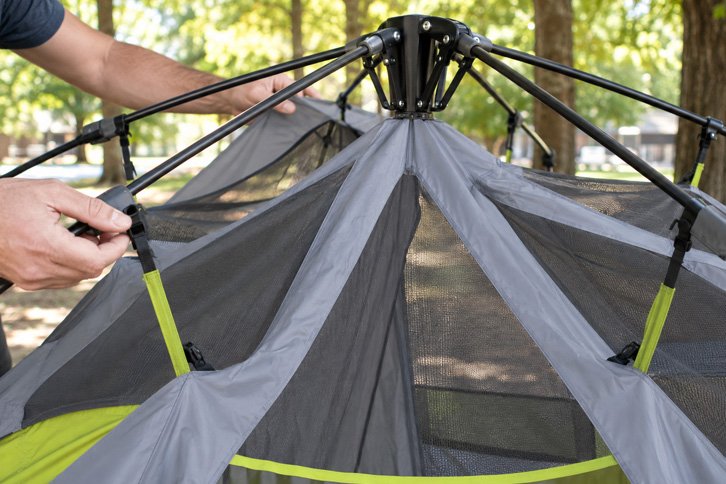
Out of the bag, this tent unfolds flat like a spider before you pull the center hub and side poles up. Once the roof poles click into place, you extend the six telescoping steel wall poles until each button locks, and the frame stands on its own. Independent testers clock solo setup at 10-15 minutes including stakes and guylines, roughly half that with a second person.
That’s slower than the “60 seconds” on the box, but it’s still faster than threading fiberglass poles through fabric sleeves while a toddler tries to climb inside the tent bag. The steel poles also feel noticeably sturdier than the poles on cheaper instant tents, which matters once you’re setting this thing up for the fifth weekend in a row.
Build Quality & Materials
The frame is where this tent earns its price. Telescoping steel poles, rather than the fiberglass you’d expect at this size, hold up well to repeated setup and teardown, and the double-stitched seams show no loose threads after normal use. The window zippers run catch-free, which sounds minor until you’re wrestling a stuck zipper at 9pm with bugs getting in.
The floor is where it cuts a corner. It’s polyethylene, essentially a tough tarp material, with no raised “bathtub” edge like pricier Coleman tents use. It handles dog claws and normal wear fine, but you’ll want a footprint or tarp underneath if you’re pitching on rocky or wet ground.
Ventilation & Hot-Weather Performance
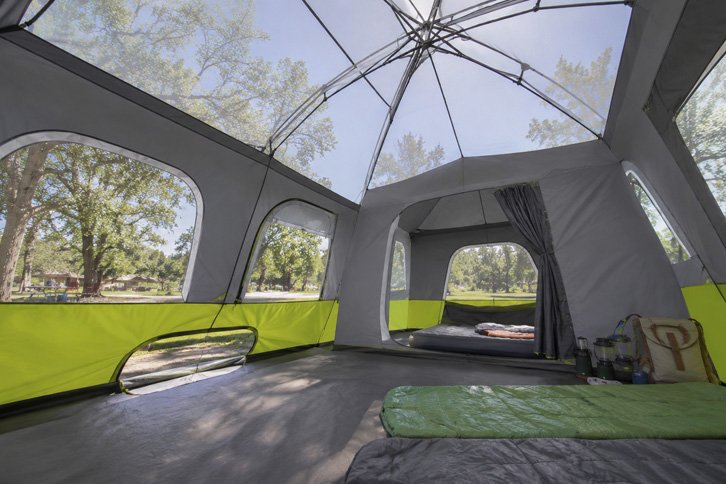
This is the tent’s strongest feature, and it’s not close. A large ground-level vent draws cooler air in near the floor while the full mesh ceiling (under the fly) lets hot air escape, creating a mild chimney effect. Combined with seven zip-open windows, it’s noticeably cooler inside than most cabin-style tents on a sunny afternoon.
If your family camps mostly in summer, this ventilation edge is the single biggest reason to pick this tent over a Coleman Dark Room-style competitor that trades airflow for light-blocking fabric.
Rain & Wind Protection
Here’s the honest trade-off for all that airflow. The rainfly is partial, meaning it covers the mesh roof but stops above the windows, so in a real downpour those windows are your only barrier and they need to be fully zipped. In light-to-moderate rain the tent stays dry. In sustained, heavy rain, water has been documented seeping in at the floor seams and window latches, spots that benefit from a pass of seam sealer before your first trip.
Wind is the other consideration. A 14-foot-wide, 6.5-foot-tall box catches a lot of air, and while the steel frame handles light breezes fine, it needs the guylines staked out in anything above 15-20 mph. This isn’t a tent for an exposed ridge or an open beach with no windbreak.
Comfort & Livability
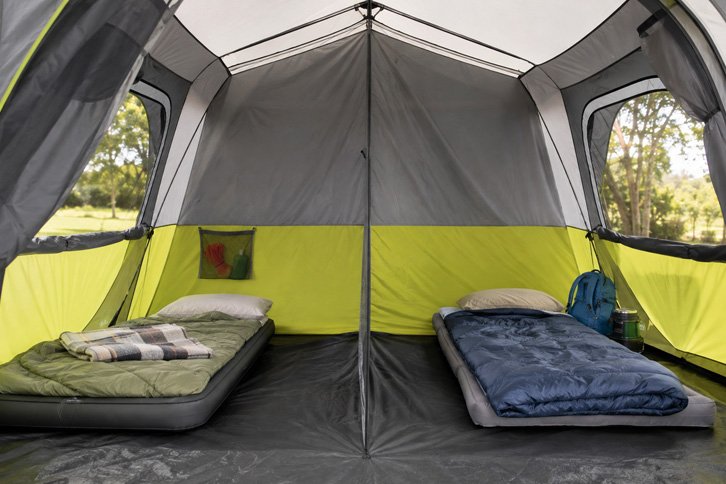
At 14 x 9 feet with vertical-ish walls, this tent lives like a small room rather than a dome. Two queen airbeds fit lengthwise with a walkable path between them and room left over for duffel bags near the door. A third queen won’t squeeze in, and running two queens side by side doesn’t work either since the tent is too narrow, so plan your sleep setup along the length.
The included room divider splits the space into two sections, each big enough for one queen bed or a few sleeping pads. It won’t block sound (you’ll still hear every snore through the mesh), but it gives real visual privacy, which matters once kids get old enough to want their own space at the campsite.
If you’re weighing whether the divider setup works better than just buying two smaller tents, our camping with toddlers guide covers how families actually split sleeping arrangements once a toddler is in the mix.
Value for Money
At roughly $280-$300, this tent sits above budget instant tents like the Ozark Trail 9-Person and below premium options like the FanttikOutdoor Alpha C6 Ultra. For that middle price, you’re getting a genuinely sturdy steel frame, real standing headroom, and the best ventilation in its size class, which is a fair trade for a rainfly that won’t hold up in a real storm.
If your trips are mostly summer weekends at established campgrounds, that trade makes sense. If you’re chasing shoulder-season trips with real weather risk, the extra $70-$130 for the full-rainfly version is worth budgeting for upfront rather than adding seam sealant and hoping for the best.
Who Should Buy This
Buy this if you camp mostly in warm weather, want a tent you and a partner can set up in minutes without an instruction manual, need real standing room for changing kids or moving gear around, and like the option to divide sleeping space between parents and kids.
Skip this if you regularly camp somewhere windy or rain-prone, drive a compact car without trunk space for a 4-foot-long bag, or need a tent under 20 lbs that one person can carry any real distance from a parking area.
Quick Comparison
Need a smaller footprint instead? Our best 8-person tents guide covers sizes closer to a family of 4-5 without the extra bulk. Prefer a traditional cabin shape without the instant-pole mechanism? Check our best cabin tents roundup for comparison.
A genuinely fast-setting-up, well-ventilated cabin tent that’s worth the price for warm-weather family trips. Buy it if you want real standing room and airflow at established campgrounds. Skip it if you’re chasing storm protection or need a compact pack size for a small car.
Check Price on Amazon →Want to keep the airflow going once you’re inside? Our best tent fans guide pairs well with this tent’s E-port for hot summer nights. And if this is part of a larger gear plan on a set budget, our family camping on a budget guide shows where a mid-range tent like this fits into a full setup.
Frequently Asked Questions
Does the Core 9-Person Instant Cabin Tent really fit 9 people?
Not comfortably. Technically you could squeeze 9 sleeping pads shoulder to shoulder, but realistically it fits 4-5 adults with gear, or 2 adults and 2-3 kids with room to move. Treat the “9-person” name as a floor-space rating, not a sleeping-bag count.
How long does it actually take to set up?
Independent testing clocks solo setup at 10-15 minutes including stakes, closer to 6 minutes with two people working together. That’s slower than the “60 seconds” marketing claim, but still much faster than a traditional pole tent this size.
Is the Core 9-Person tent waterproof?
It’s water-resistant, not storm-proof. It handles light-to-moderate rain fine, but the partial rainfly leaves the windows as your only barrier in heavy rain, and some owners apply seam sealant at the floor seams before trips into wetter climates.
What’s the difference between the standard and full-rainfly versions?
The standard model (reviewed here) has a rainfly that covers the roof mesh but stops above the windows. The full-rainfly version, priced roughly $70-130 higher, extends coverage down over the windows for better protection in regular rain.
Will this tent fit in a compact car?
Maybe not sideways. The packed bag runs about 46-48 inches long, which fits fine in most SUVs and minivans but can be a tight squeeze in a smaller sedan trunk. Measure your trunk before buying if you’re not sure.