Short answer: if your kids are under 5, or this is your family’s very first outdoor trip, glamping is the smarter starting point. If your kids are 6 or older and you plan to go outdoors more than twice a year, traditional camping wins, the gear pays for itself fast and the kids get more out of it.
Most articles on this topic end with “it depends on your preferences,” which helps nobody. So we’re going to be specific: real costs over five years, a decision framework based on your kids’ ages, and an honest look at what each option actually feels like when you’re the parent responsible for everyone having a good time.
Camping vs Glamping: Side-by-Side
The Real Cost Math (That Nobody Runs)
Most comparisons stop at “glamping costs more per night.” That’s true but incomplete, because it ignores the shape of the spending. Camping is front-loaded; glamping is pay-as-you-go.
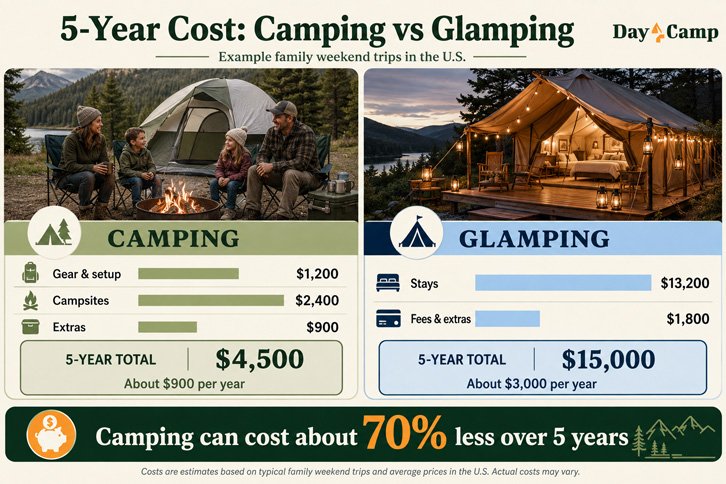
Here’s what four nights outdoors per year actually costs a family of four over five years:
Traditional Camping – 5 Year Total
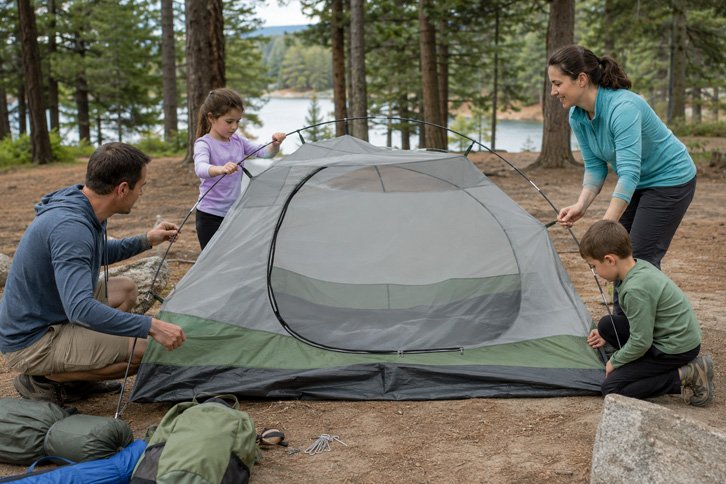
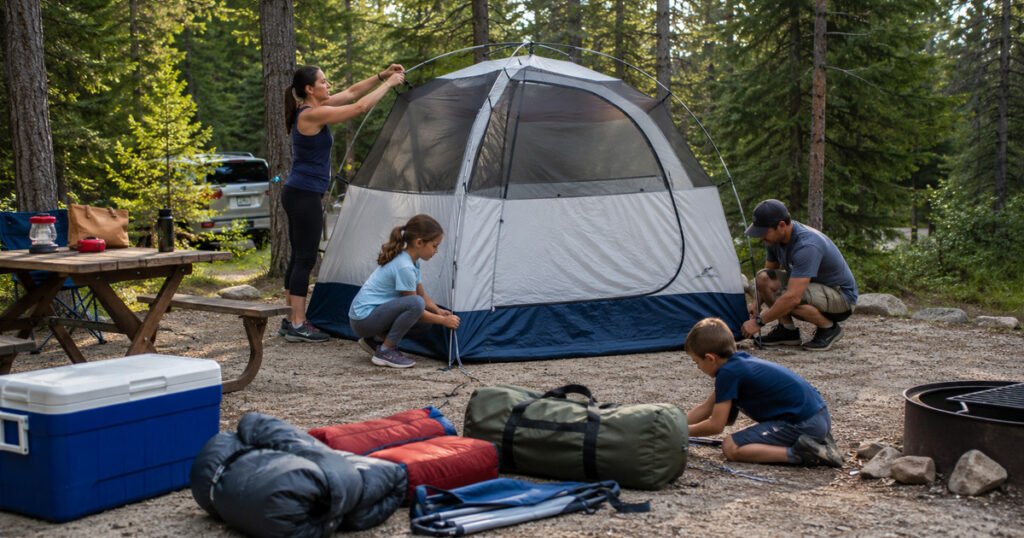
- Year 1 gear investment: $500 (mid-range tent $180, two double sleeping bags $120, sleeping pads $80, stove $70, cooler $50)
- Campsite fees: $35/night × 4 nights = $140/year
- Replacement/repairs over 5 years: ~$150
- 5-year total: $500 + ($140 × 5) + $150 = $1,350
- Cost per night outdoors: ~$67
Glamping – 5 Year Total
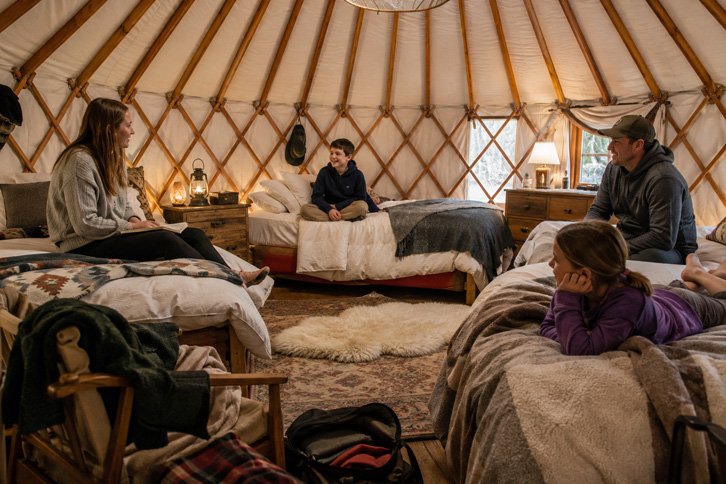
- Gear investment: $0
- Nightly rate (mid-range): $175/night × 4 nights = $700/year
- 5-year total: $3,500
- Cost per night outdoors: $175
So glamping runs roughly 2.5× more expensive over five years at four nights per year. But flip the frequency and the picture changes completely.
If your family only goes outdoors once every two years, two nights total in five years, camping costs $500 in gear plus $70 in fees ($570 for two nights, or $285/night), while glamping costs $350. Glamping wins.
Decide by Your Kids’ Ages
This is the axis that actually matters, and it’s missing from nearly every other comparison out there.
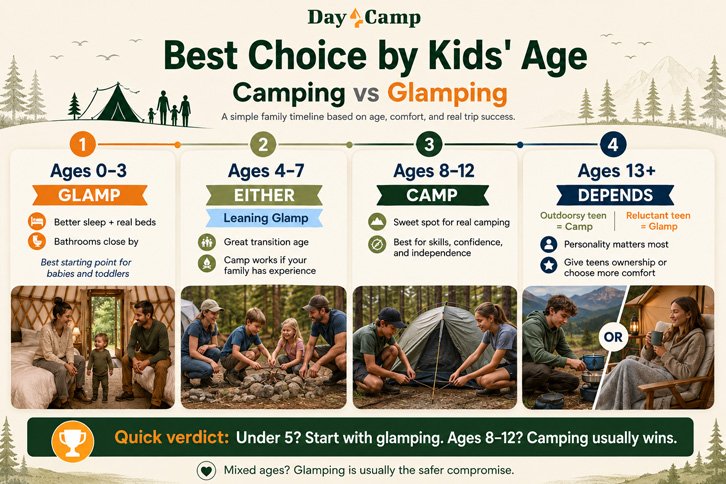
Ages 0–3: Glamp
Babies and toddlers make traditional camping genuinely hard. They wake at 5am, get cold fast, need diaper changes at inconvenient moments, and are physically incapable of understanding “please don’t touch the fire.”
Glamping solves most of this. Solid walls block wind and morning light. A real bed or travel crib means better sleep for everyone. Nearby bathrooms mean fewer 2am expeditions across wet grass with a headlamp and a screaming toddler.
You’ll still get the campfire and the nature time. You just won’t be exhausted.
Ages 4–7: Either, Leaning Glamp
This is the transition zone. Kids this age love outdoor everything but still need a lot of managing. If your family is new to camping, glamping is the lower-risk way to find out whether everyone enjoys it before you spend $500 on gear.
If you’ve camped before and know your kids handle it well, traditional camping is completely doable at this age, and this is when kids start being genuinely helpful (carrying things, gathering kindling, “helping” with the tent).
Ages 8–12: Camp
This is the sweet spot for traditional camping. Kids this age can carry their own pack, help pitch the tent, learn to build a fire safely, and take real pride in doing it. The independence and skill-building is the whole point, and glamping doesn’t offer that.
They also complain less about discomfort at this age than either toddlers or teenagers. Take advantage of it.
Ages 13+: Depends on the Teenager
Some teens love the challenge and self-sufficiency of real camping. Others want a shower and WiFi and will make their misery everyone’s problem.
Be honest about which kind of teenager you have. A treehouse or dome glamping stay wins over reluctant teens far more reliably than a tent does. Alternatively, give teens ownership of a camping trip, let them plan the route or the meals, and engagement usually follows.
Pros and Cons: Traditional Camping
Pros and Cons: Glamping
The Hybrid Path Most Families Actually Take
Here’s what the other articles miss: this isn’t a permanent identity choice. Most families we know don’t pick one and stick with it forever. They move along a path.
Year 1: Glamp once. Find out whether your family enjoys being outdoors at all, without a $500 gamble. Do the kids love the trails and campfire, or do they spend the whole time asking to go home?
Year 2: If the answer was positive, buy gear gradually, a tent and sleeping bags first, then a stove and cooler. Camp two or three nights. Keep one glamping trip in the rotation for when you want a break from setup.
Year 3+: Camp primarily. Glamp occasionally, for winter trips, for trips with grandparents, or when the weather forecast is genuinely miserable.
This approach spreads the cost, avoids buying gear you’ll never use, and lets your family discover its own preferences without committing to either camp before you know.
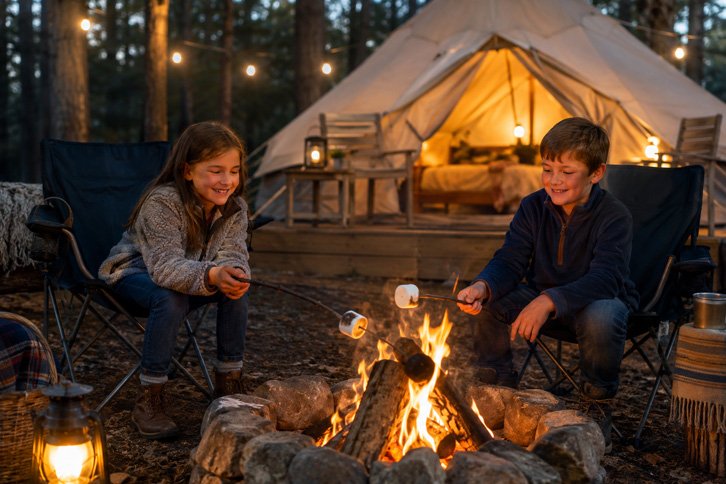
Which Costs More: A Detailed Scenario
Let’s make this concrete with a real family: two adults, an 8-year-old, and a 5-year-old, planning one 3-night trip this summer.
Camping route:
- Tent (6-person, mid-range): $180
- Two double sleeping bags: $120
- Sleeping pads ×2: $80
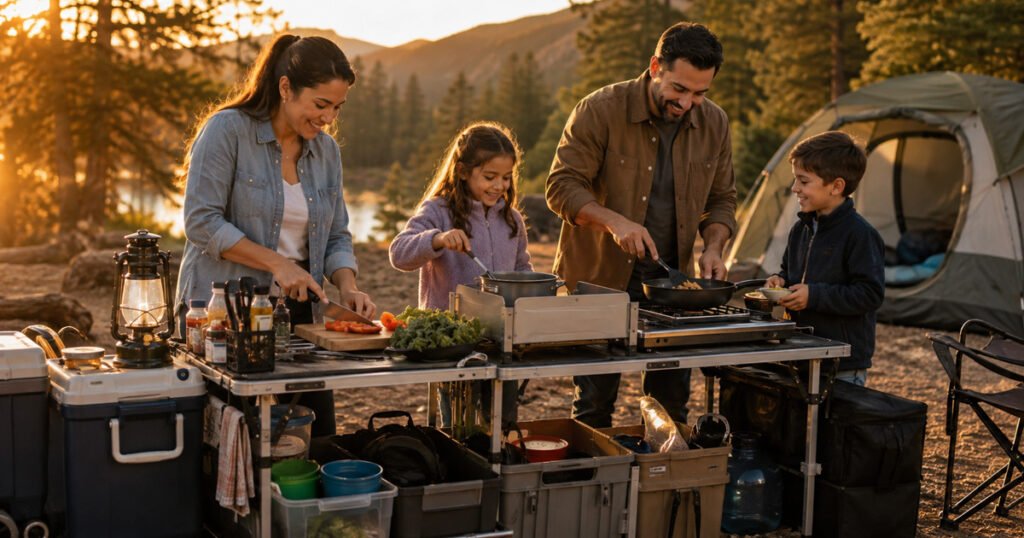
- Two-burner stove: $70
- Cooler: $50
- Campsite: $35 × 3 nights = $105
- Trip total: $605 ($202/night)
- Every future 3-night trip: $105 ($35/night)
Glamping route:
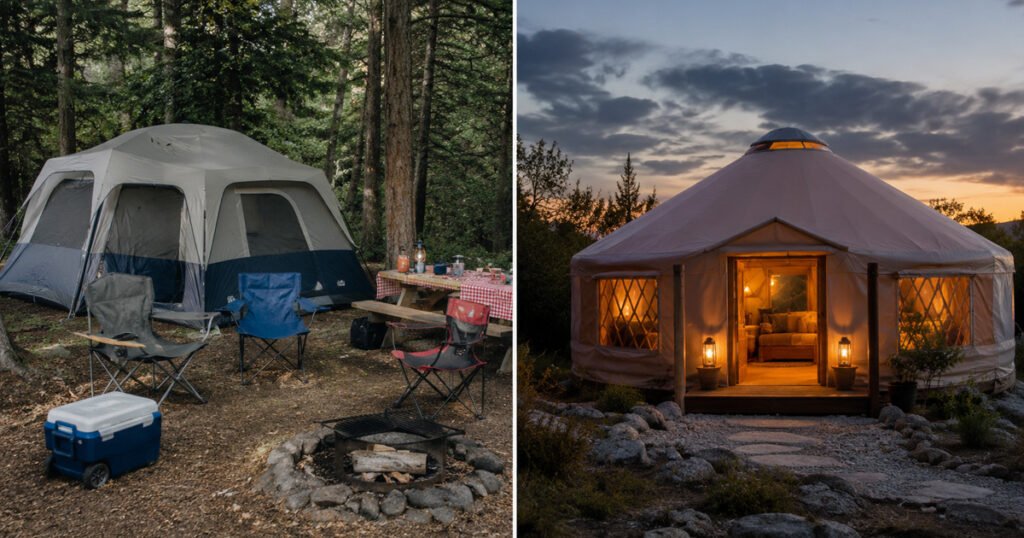
- Safari tent or yurt for 4: $175 × 3 nights = $525
- Trip total: $525 ($175/night)
- Every future 3-night trip: $525
First trip: glamping is actually cheaper. Second trip onward: camping is five times cheaper. By trip three, camping has saved this family over $800.
That’s the whole calculus in one paragraph. If you’ll go more than once, camp. If this is a one-time experiment, glamp.
Verdict: Which Should You Pick?
Choose traditional camping if:
- Your kids are 6 or older
- You’ll realistically go outdoors more than twice
- You want your kids to build outdoor skills and independence
- Budget matters over the long run
- You value spontaneity and being able to go anywhere
Choose glamping if:
- You have a baby or toddler
- This is your family’s first outdoor trip and you’re not sure anyone will like it
- Someone in the group has mobility or health needs that make ground sleeping difficult
- You’re bringing grandparents or a reluctant partner
- You’re going in shoulder season or unpredictable weather
- Sleep quality is non-negotiable for your family’s happiness
Do both if: You’re like most families. Glamp when the conditions or the crew call for comfort. Camp when you want the full experience and the savings. Neither choice is a commitment.
The best outdoor trip is the one your family actually takes. A yurt with happy kids beats a tent with miserable ones, and a $35 campsite with happy kids beats both.
Frequently Asked Questions
What is the main difference between camping and glamping?
Traditional camping means bringing and setting up your own gear, tent, sleeping bags, stove, and cookware. Glamping means staying in a pre-furnished structure like a yurt, safari tent, or cabin where real beds, lighting, and often a bathroom are already in place. Both put you in nature; only camping requires you to build your own setup.
Is glamping more expensive than camping?
Per night, yes, glamping runs $50–$300+ versus $20–$50 for a campsite. But camping requires $300–$900 in upfront gear for a family of four. If you only go outdoors once, glamping is often cheaper overall. If you go more than 4–5 nights total, camping becomes dramatically cheaper.
Is glamping or camping better for kids?
It depends on their age. For kids 0–5, glamping is easier on everyone, better sleep, closer bathrooms, and weather protection. For kids 6–12, traditional camping is better because they can participate in setup, learn fire skills, and build real confidence. For teens, it depends on the individual teenager.
Can you camp and glamp on the same trip?
Yes, and many families do. A common approach is glamping for one or two nights at the start of a trip and camping for the rest, or booking a glamping site as a rain contingency. Some campgrounds offer both tent sites and glamping cabins in the same location.
Do you still get the outdoor experience when glamping?
Yes. You still hike, build campfires, cook outside, stargaze, and disconnect from screens. What you skip is the setup labor and the discomfort of sleeping on the ground. For families with young kids, that trade often means everyone actually enjoys the outdoor parts more.
How much gear do I need to start camping with a family?
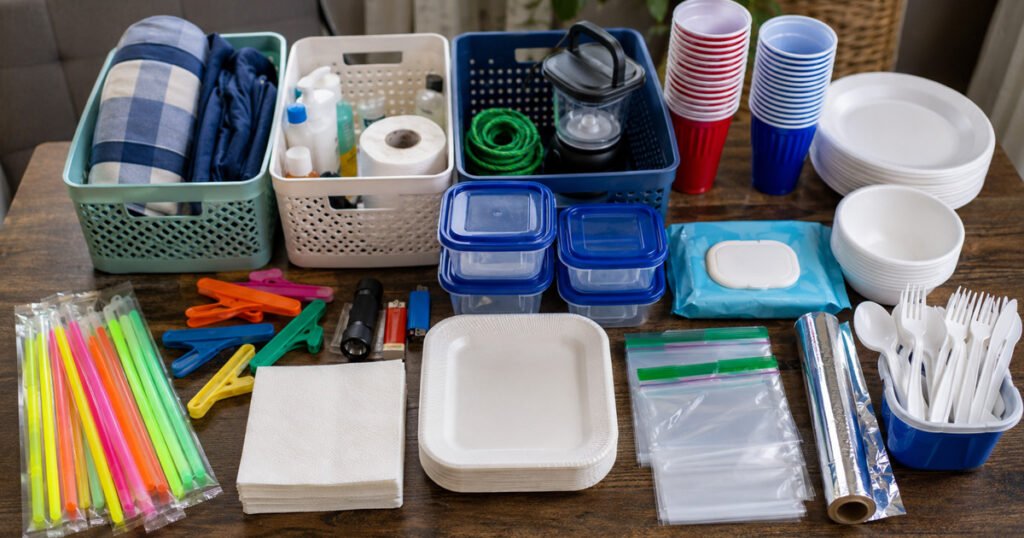
For a family of four, budget $300–$900 depending on quality. The essentials are a tent, sleeping bags, sleeping pads or air mattresses, a two-burner stove, a cooler, and basic cookware. You can start cheaper by borrowing or renting, and by adding gear gradually across seasons.
Is glamping worth it for a first camping trip?
For most families, yes. Glamping removes the two biggest failure points of a first trip, bad sleep and a setup disaster, so you find out whether your family enjoys being outdoors before committing to gear. If everyone loves it, buy gear for trip two.