Short answer: the Weber Q1200 is the best portable grill for most camping families in 2026. It runs on a 1 lb propane canister, lights with a button, and the cast-iron grates hold heat well enough to cook eight burgers without a cold spot. If you’re feeding five or more people, the Coleman RoadTrip 225 gives you more surface and two independent burners for around half the price. And if you just want something cheap that works, the Coleman Fold N Go runs under $90.
One more thing nobody else tells you: your grill’s fuel type decides whether you can cook at all. Most state parks ban charcoal during a fire restriction but still allow propane, so a charcoal grill can leave your family eating cold sandwiches on the exact weekend you planned a cookout.
We learned that the hard way in a Florida state park in August, standing over a bag of briquettes we weren’t allowed to light. Here’s what actually works when you’re cooking for kids at a campsite.
Quick Top 3 Picks
- Best Overall: Weber Q1200, cast-iron grates, real heat, works during propane-only fire bans
- Best Budget: Coleman Fold N Go, under $90, folds flat, fine for weekend trips
- Best Premium: Weber Traveler, 320 sq in and a built-in cart, for families who cook big
Comparison: The 6 Best Camping Grills
How Much Grill Space Does Your Family Actually Need?
Every review site lists cooking area in square inches and then leaves you to guess what that means. Here’s the translation we use when we’re packing:
The number that matters is whether everyone eats at the same time. With kids, cooking in two rounds means the first batch goes cold while somebody melts down over waiting. If you have three or more kids, size up.
1. Weber Q1200 – Best Overall
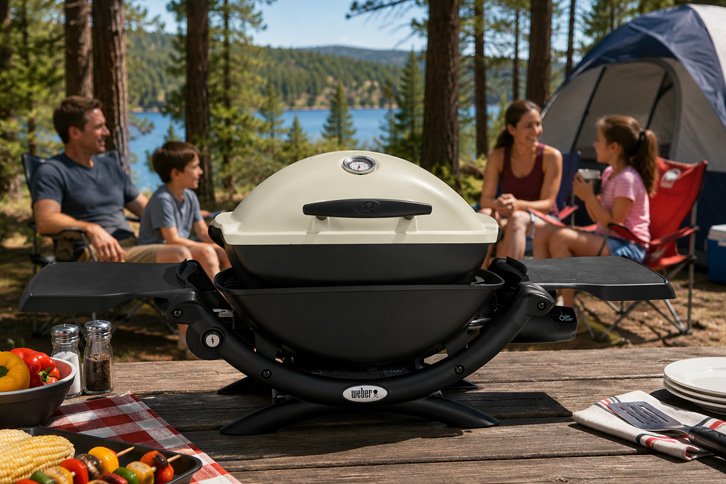
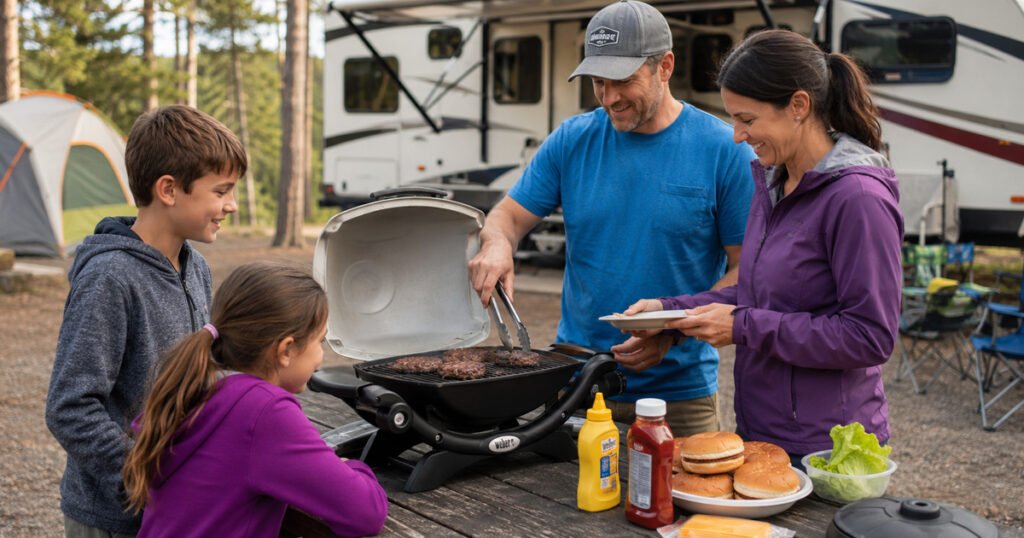
The Q1200 is the grill you buy once and stop thinking about. It runs on a single 1 lb propane canister, has a push-button igniter, a built-in lid thermometer, and porcelain-enameled cast-iron grates that actually sear instead of steaming your food into gray discs.
The 189 sq in surface handles about eight burger patties, which covers a family of four with seconds. Setup is opening the lid and turning a knob, no assembly at the campsite, no charcoal chimney, no waiting 25 minutes for coals to ash over while your kids ask when dinner is.
Weight is the trade-off. At roughly 30 lbs it isn’t something you carry far from the car, and the lid latch takes a little practice. But the build is genuinely good, and it’s the model most likely to still be in your trunk in ten years.
Best for: families of 3-5 who want one reliable grill and don’t want to fuss with charcoal.
Skip it if: you’re feeding six or more, or you need to keep one side low while searing on the other.
2. Coleman RoadTrip 225 – Best Value
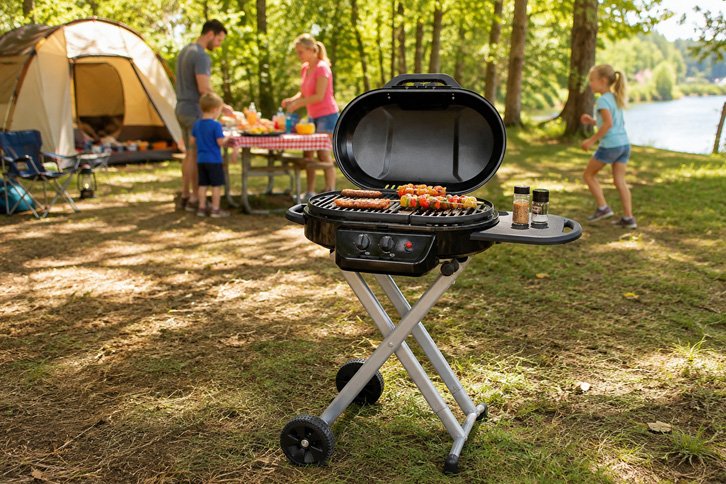
The RoadTrip 225 is the grill we recommend most often to families on a budget, because it does the one thing the Weber Q1200 can’t: two independently adjustable burners. That means burgers searing on one side while hot dogs stay warm on the other, which is exactly how family dinners actually go.
You get 225 sq in of cast-iron grate, InstaStart push-button ignition, and 11,000 BTU across the two zones. MSRP hovers near $200, but this thing goes on sale constantly, we’ve seen it at $99 at Dick’s and around $140 most of the year. Watch for it.
The build is Coleman, not Weber. The lid hinge and legs feel lighter, and the enamel chips if you toss it in the trunk without a cover. Treat it gently and it lasts several seasons.
Best for: families of five or more who want two-zone cooking without paying Weber money.
Skip it if: you camp 20 weekends a year and want something that’ll shrug off constant abuse.
3. Coleman Fold N Go – Best Budget
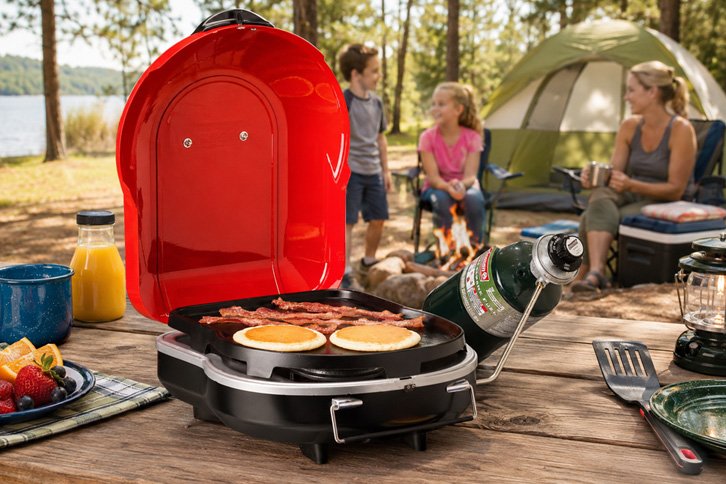
Under $90, folds down to about the size of a briefcase, and weighs around 12 lbs. The Fold N Go is the grill for families who camp three or four times a year and can’t justify $270 for something that lives in the garage the rest of the time.
You get roughly 105 sq in of cooking surface, which is honestly small, think four burgers at a time. For a family of four that means cooking in two rounds, so plan on serving kids first and eating last, which is probably already your life.
Heat distribution is uneven toward the edges, and there’s no thermometer. But it lights instantly, it’s propane so it survives fire bans, and it packs into a corner of the trunk instead of eating half of it.
Best for: occasional campers, small families, or as a second grill for the tailgate.
Skip it if: you’re feeding more than four people and hate cooking in shifts.
4. Weber Traveler – Best Premium
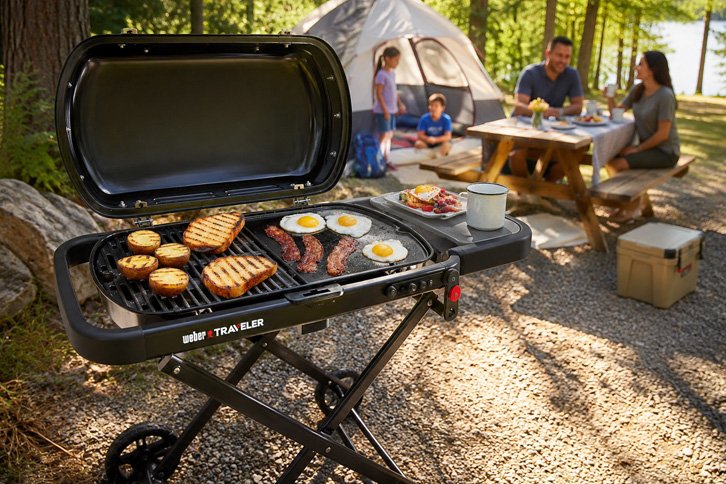
The Traveler shows up as “best overall” on almost every major review site, and it earns it, 320 sq in of cooking space, a single-motion fold that one adult can do in about 10 seconds, and a built-in cart with wheels so you’re rolling it to the picnic table instead of carrying it.
For a family of six or a group campsite where you’re feeding two families, this is the one. Heat is even edge to edge, the lid seals well enough to roast a whole chicken, and the whole thing stands at counter height so you’re not hunched over a picnic table for 40 minutes.
The price is the problem: $349 to $449 depending on the finish and where you buy. It also takes up real trunk space, roughly the footprint of a folded stroller. If you camp four times a year, this is a lot of grill.
Best for: families of six or more, group camping trips, and anyone who grills at home too.
Skip it if: you camp a few times a year or your trunk is already full of tents and coolers.
5. Coleman Cascade 3-in-1 – Best Grill/Stove Combo
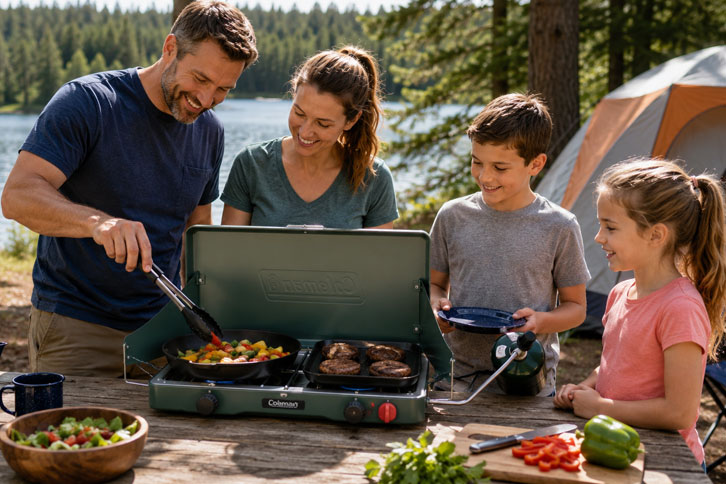
If you only have room for one cooking device, the Cascade 3-in-1 is the smart answer. It’s a two-burner camp stove that swaps between a standard stove top, a grill grate, and a flat griddle, so one box handles pancakes at 7am and burgers at 6pm.
The griddle is the sleeper feature. Camp breakfast with kids means pancakes, eggs, and bacon all at once, and a flat surface beats a grate every single time. The grill grate isn’t as good as a dedicated Weber, but it’s genuinely close enough for hot dogs, brats, and chicken.
Expect $180-230 depending on configuration and whether the grill/griddle plates are bundled or sold separately, which is the annoying part, check the listing carefully before you buy.
Best for: families packing light who want breakfast and dinner covered by one unit.
Skip it if: grilling is the whole point of your trip and you want proper sear marks.
6. UCO Flatpack – Best Charcoal Grill (and Fire Pit)
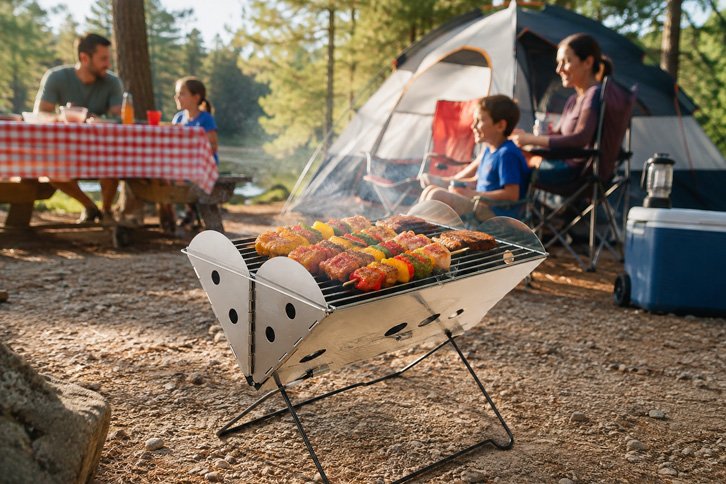
The Flatpack is the one charcoal pick we’d take camping, mostly because it does double duty as a small wood-burning fire pit. It packs completely flat into a carry bag, weighs about 5 lbs in the mini version, and assembles in under a minute with no tools.
For families, the appeal is the after-dinner shift: grill burgers, then throw a couple of small logs in and let the kids roast marshmallows over the same box. That’s two pieces of gear collapsed into one.
The catch is the fuel. Charcoal takes 20-25 minutes to reach cooking temperature, produces ash you have to pack out, and, the big one, gets banned first when a park declares fire restrictions. Bring it as a bonus, not as your only cooking plan.
Best for: families who want charcoal flavor and a compact fire pit in the same purchase.
Skip it if: you camp in dry western states in summer, where fire bans are close to routine.
Buying Guide: How to Choose a Camping Grill
Propane vs. charcoal (this decides more than flavor)
Propane lights in seconds, holds a steady temperature, produces no ash, and stays legal at most parks during fire restrictions. Charcoal tastes better to a lot of people and costs less upfront, but takes 20-25 minutes to heat, leaves ash you pack out, and is usually the first thing banned when conditions get dry.
For families, propane wins on almost every practical measure. Hungry kids and a 25-minute charcoal wait are a bad combination.
Cooking area
Use the table earlier in this article. If you’re between two sizes, size up, you can always cook less on a bigger grill, but you can’t fit ten burgers on 105 sq in.
Setup time
Count the steps from “car parked” to “food on the grate.” A push-button igniter and a fold-out design gets you there in about five minutes. Assembling legs, threading a regulator, or lighting a charcoal chimney adds 20 minutes to an evening when everyone’s already tired.
Weight and packed size
Car camping means you can afford weight, but not volume. Measure your trunk with the cooler and tent already in it before you commit to something Traveler-sized.
Cleaning
Cast-iron grates cook better but need oiling. Nonstick grates wipe clean but scratch. Removable grates that fit in a camp sink are worth more than any feature on the box, because someone has to wash them at 9pm with a headlamp on.
Common Mistakes Families Make
- Bringing charcoal only. One fire restriction and dinner is canceled. Propane, or propane plus charcoal.
- Buying too small to save $60. Cooking in two rounds means half your family eats cold food.
- Forgetting the fuel. A 1 lb propane canister burns roughly 1.5-2 hours on high. Bring two per weekend, minimum.
- Packing it hot. Grills stay hot for 30+ minutes. Melted cooler lids and scorched trunk liners are a real and expensive mistake.
- No flat surface. Picnic tables at campgrounds are often warped or wet. A stable table matters more than you’d think.
Final Verdict
Best Overall – Weber Q1200 (~$269). The most reliable grill on this list. Cast-iron grates, fast setup, propane simplicity, and a build that outlasts every budget model here. If you camp more than a handful of times a year and don’t want to think about your grill again, buy this.
Best Budget – Coleman Fold N Go (~$85). Small, light, and cheap enough that it doesn’t matter if it lives in the garage nine months a year. Cook in two rounds and it’s fine.
Best Premium – Weber Traveler (~$349-449). Real 320 sq in, rolls like a suitcase, and stands at counter height. Overkill for four people, exactly right for six or more.
Best Value – Coleman RoadTrip 225 (~$100-200 depending on sale). The pick we recommend most often. Two-zone cooking and enough space for five, if you buy it on sale instead of at MSRP.
Frequently Asked Questions
Are grills allowed at campgrounds during a fire ban?
Usually yes for propane and often no for charcoal. Florida, Virginia, Washington, and California state parks all publish rules permitting gas or propane cooking during fire restrictions while limiting or banning charcoal and wood. Rules vary by park and by season, so check the specific campground’s alerts page before you leave home.
What size camping grill does a family of four need?
Look for at least 180-225 sq in of cooking surface. That’s roughly 8-10 burger patties, which lets a family of four eat together in one round instead of cooking in shifts. Families of six or more should aim for 280-320 sq in.
Is propane or charcoal better for camping with kids?
Propane, for almost every family. It lights in seconds instead of taking 20-25 minutes to reach cooking temperature, holds a steady temperature so food cooks predictably, leaves no hot ash to dispose of, and stays legal under most park fire restrictions. Charcoal gives better flavor, but the wait and the cleanup are hard with hungry kids.
How long does a 1 lb propane canister last on a camping grill?
Roughly 1.5 to 2 hours of cooking on high heat, and longer on medium. For a weekend trip with two grilled dinners, bring at least two canisters. A larger 20 lb tank with an adapter hose is more economical if you camp often and have trunk space.
Can I use a camping grill on a picnic table?
Yes, if the grill has heat-shielded feet and the table is stable and level. Check the manufacturer’s guidance first, since some models require a specific clearance underneath. Many campgrounds have warped or damaged picnic tables, so a dedicated camp table or a flat rock surface is often safer.
How do I keep kids safe around a hot camping grill?
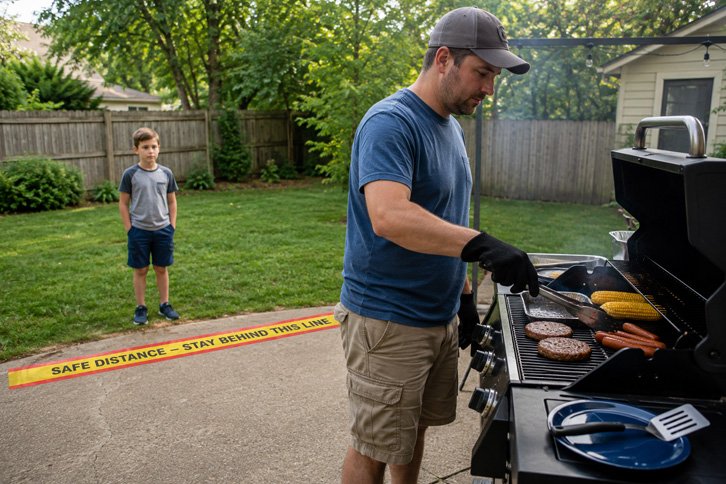
Set a visible “three big steps back” boundary before you light the grill, and point it out to every child. The lid and body stay hot for 20-30 minutes after shutdown without looking hot, so keep the boundary in place until the grill is cool to the touch. Giving older kids a real job, like handing over tongs while you stand at the grill, keeps them engaged instead of wandering into the hot zone.
Do I need to clean a camping grill before packing it?
Yes. Burn the grate on high for about five minutes after cooking, then scrape it while hot. Grease left on a grate goes rancid fast in a warm trunk and attracts wildlife at your next campsite, which is a much bigger problem than a dirty grate.